

Folding e-bikes attract two distinct buyers: the city commuter with no storage space and the traveller who wants a bike in the boot of a car or motorhome. They share a product category but buy for different reasons. Dealers who treat them as one customer usually struggle to explain the value.
What the urban commuter actually needs
For an apartment dweller, the folding mechanism is about a doorway, a lift and a corner of the hallway. The bike must fold in seconds, stay clean enough to bring inside and still be comfortable enough to ride five days a week. That pushes the specification towards suspension, a rear rack and lights, not just a compact frame.
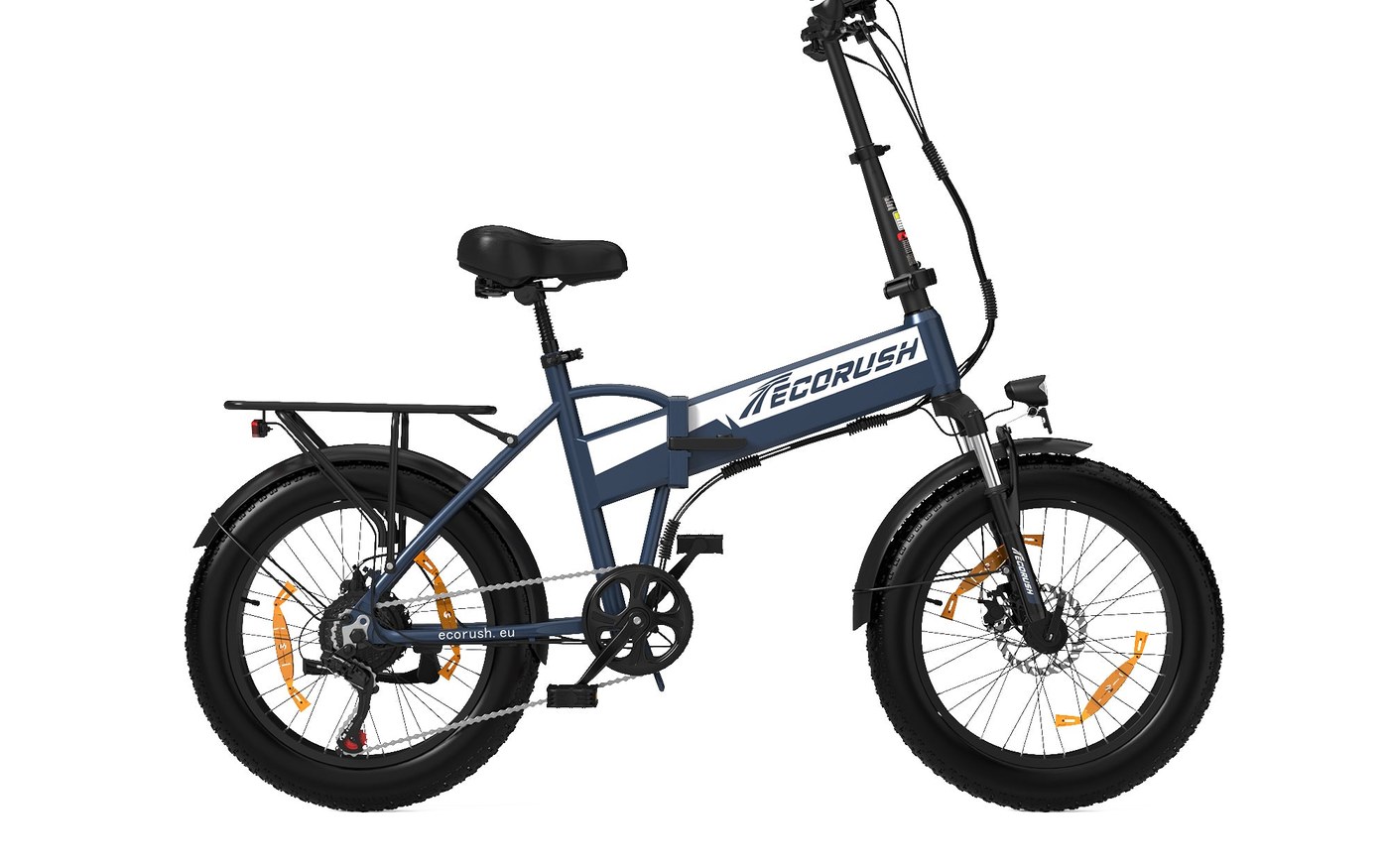
The ECO R2 is built around that brief: folding aluminium frame, 499Wh removable battery, up to 100 km range, 20×4.0 puncture-resistant tires, front suspension, suspension seat post, LCD display, Shimano 7-speed and a rear rack. It is a complete commuter that happens to fold.
What the traveller actually needs
For a motorhome or car traveller, weight and folded dimensions come first, along with tires that can handle campsite gravel and coastal paths. The ER10S — a 20×4.0 folding fat-tire model — is easier to lift and simpler to live with. Its wide tires also mean less worry about poor surfaces at the destination.
Three questions to ask before recommending a model
- Where will it be stored? A fifth-floor apartment without a lift changes the weight equation completely.
- How far is the daily journey? A 20 km round trip and a 70 km round trip need different battery capacities.
- Will it be carries, lifted or rolled? Practice the fold in front of the customer. If they cannot lift it, the bike will stay at home.
Demonstration beats description
Keep one folding bike unfolded and one folded on the shop floor. Time the fold during the demonstration. Let the customer lift the bike themselves. These two actions answer more objections than a paragraph of specification ever will.
Avoid the common positioning mistake
Do not sell folding bikes as “small bikes”. Sell them as bikes that remove a storage or transport constraint. A commuter does not want a compromise; they want a full bike that fits their life. The product language should reflect that.
A folding e-bike is not a lesser bike. It is the right bike for a rider whose biggest barrier is space, not performance.
Talk to us about dealer terms
ECORUSH offers the ER10S and ECO R2 with flexible MOQs and full technical documentation. Contact the B2B team for pricing and sample availability.
What actually wears out on a folding mechanism
The hinge is the component a folding bike lives or dies by. Ask suppliers what material the latch uses, whether it can be adjusted for wear and whether replacement parts are stocked. A well-designed hinge stays tight after thousands of folds; a poor one develops play that makes the bike feel loose and eventually becomes a safety concern.
Show the customer how to check for play: unfold the bike, hold the frame and try to move the hinge sideways. If there is movement, the latch needs adjustment. Teaching this at handover turns a potential complaint into a sign of expertise.
Planning a multimodal journey around the bike
For “metro plus bike” commuters, the journey has three parts: getting to the station, carrying the bike on public transport and riding the last section. Each part imposes a different requirement. The first needs lights and a comfortable position; the second needs compact folded dimensions and a clean bike; the third needs enough range for the final kilometres.
Ask customers to describe their actual route, including the stairs. A bike that folds in seconds is still unhelpful if the rider cannot carry it up three flights. This is where a lighter model earns its price, and where a dealer’s honest advice matters most.
Accessories that change the ownership experience
- A carry strap or shoulder sling for the metro section of the journey.
- A battery cover that keeps dirt off the contacts when the pack is carried indoors.
- Fenders for riders who travel in work clothing.
- A small rear light that stays visible when the bike is folded and stored in a hallway.
Offer these at the point of sale rather than as an afterthought. They improve the first month of ownership, which is when habits form.
Two customers, two conversations
The city commuter asks about storage and range. The motorhome traveller asks about weight and whether the tires handle campsite gravel. Both can be answered with the same bike family, but the emphasis differs. Train staff to ask one question first: “Where will you take it?” The answer determines the rest of the conversation.
For travellers who need more distance once they arrive, the 499Wh folding commuter e-bike is a natural step up from an entry folding model. Having both in stock gives the dealer an upgrade path rather than a dead end.
Looking for a reliable e-bike partner?
Explore our CE/EN15194 certified lineup and factory-direct B2B pricing.